Nepticuloidea (2)
Nepticulidae (5)
Opostegidae (7)
Please view this page in full in order to see a video detailing how you can start to get to know your Scratchpad
Roscidotoga lamingtonia most closely resembles R. callicomae, but it also has some similarities to R. sapphiripes, the edged scape, metallic collar with lamellate scales and bluish metallic thorax and forewing base are characteristic in combination. The male genitalia also resemble R. callicomae, but are easily separated by the larger number of cornuti and the long unforked dorsal process on the aedeagus. R. eucryphiae also has more cornuti (17), which are arranged in a U-shape; the cornuti are of even size, unlike in R. lamingtonia, and a cornutus associated with the base of the ejaculatory duct is lacking. The valva in R. eucryphiae also differs in having the digitate process more humped laterally, and not extending beyond the tegumen / uncus. The female genitalia differ from R. callicomae and R. eucryphiae by the larger number of convolutions in the ductus spermathecae and the larger number of setae on T8.
Male. Forewing length 2.1–2.3 mm (holotype 2.3), wingspan 5.0–5.1 mm.
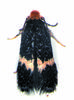
Live moth in rest slightly bell-shaped. Head: frontal tuft entirely yellowish orange, or two lateral tufts on vertex darker, brownish; collar comprising lamellar scales, bluish metallic; antenna with 33–36 segments (holotype 36), scape large, longer than width of vertex between antennae, cream white, posterior third grey; flagellum grey brown. Thorax bluish metallic; forewing dark fuscous, basal third bluish metallic; silver metallic scales with bluish reflections scattered in distal two thirds, forming a triangular oblique streak from costa near middle slightly variable in size, and a very small to almost absent opposite dorsal spot; extent of silver markings variable; cilia line present. Hindwing and cilia grey brown; underside of both wings dark fuscous.
Abdomen upperside fuscous, almost black, no visible anal tufts; underside paler, silvery grey.
Male genitalia. Capsule 350–365 µm long. Vinculum with large ventral plate, slightly or not indented. Tegumen/uncus with two widely separated posterior processes, each slightly serrate, with ca. 4. strong setae, in addition 2 strong setae dorsally on tegumen. Valva 205–250 µm long, basally broadly triangular, narrowing towards two thirds, ending in a setose digitate process; transtilla interrupted in middle, sublateral processes rather long. Aedeagus 325–380 µm long, with long pointed dorsal process (dp in Fig. 7) and short triangular ventral process (vp in Fig. 7), in situ between valvae; vesica with one spine-like cornutus near base of ejaculatory duct, associated with indistinct sclerotization; distally one long curved cornutus (130–145 µm long) with thickened and split apex, next to a group of 9–11 dagger shaped cornuti of variable size.
Female genitalia (from pupa). Total length ca 1000 µm. S8 broadly rounded. T8 a narrow rounded band with ca. 22 setae in total. Anterior apophyses with broadly lobed bases, with very short anterior apodemes, posterior apophyses narrow, rather long. Vestibulum with some indistinct sclerotizations, ending in small folded accessory sac of about 200 µm long. Ductus spermathecae with ca. 6 convolutions. Corpus bursae with small diverticulum (d in Fig 12 in original description), otherwise completely without structures.
Larva. Green, head pale brown, feeding with ventral side up. Headcapsule ca 440 µm long, 445 µm wide. A10 with 4 pairs of setae. Larva agrees otherwise with generic description, as far as could be judged. The single larva was taken from a cocoon and many characters are obscured by the presence of a pupal skin inside the larval integument.
Pupa. Abdominal segments 2–8 each with 4–5 rows of rather small spines, as in R. callicomae.
Host plant. Sloanea woollsii F. Muell. (Elaeocarpaceae), a tree of warm temperate and subtropical rainforest, common in coastal NSW and Queensland.
Egg. On either surface of leaf, in 12 out of 28 mines on upper surface, usually against a vein.
Mine: A more or less contorted linear gallery with linear frass throughout, later slightly dispersed, but still leaving broad margins; exit-hole on upperside.
Cocoon: brown.
Larvae were collected on 8 and 13 July and 12 and 19 August; adults emerged indoors (in The Netherlands!) on 3 and 11 October.
Hostplant: Sloanea woollsii F. Muell. (Elaeocarpaceae)
Australia: southern Queensland and northern New South Wales, McPherson Range.
Within Lamington National Park, Sloanea woollsii is a widespread and common tree in warm temperate and subtropical rainforest, and also R. lamingtonia appears to be rather common. We found mines on several sites along the Lower Bellbird, Border Track and Daves Creek Circuits, ranging from about 500 m to 840 m in altitude.
Nepticuloidea: Roscidotoga lamingtonia
The bluish to purplish metallic reflections of the forewing combined with the triangular
silver mark on the costa serve to distinguish species of this genus externally.
In the male genitalia, the elongate anterior extension of the vinculum, the
setose lobes appressed to the tegumen, the reduction of the gnathos, and the apical
processes of the aedeagus are together diagnostic. The weakly sclerotized bursa
and lobed bases of the anterior apophyses in the female genitalia are
distinctive.
Synapomorphies:
(1) Forewing with silver streak from costa and apical suffusion of metallic
scales.
(2) Gnathos strongly reduced or lost.
(3) Tegumen with appressed setose lobes (possibly representing a modified
uncus).
(4) Anterior extension of vinculum elongate.
(5) Pectinifer strongly reduced.
(6) Transverse bar of transtilla broken in middle.
(7) Aedeagus with one ventral and one dorsal process.
(8) Apophyses anteriores with expanded bases.
(9) Corpus bursae with diverticulum. (Not known with certainty for R.
sapphiripes.)
Adults. Head capsule: Labial palpus 3-segmented;
galea short, not extending beyond labial palpus; maxillary palpus 5-segmented,
ratio of segments from base approximately 0.2: 0.4: 0.7: 1.6: 1; interocular
index (Davis 1975) 0.8. Collar consisting of piliform scales. Thorax and
forewing fuscous with strong bluish or purplish reflections; forewing costa
with a triangular silver mark 2 3 along its length; apex
of forewing with suffusion of silver or bluish metallic
scales. Hindwing grayish, without specialized scales; 6–8 costal bristles in
male. Underside: forewing without subdorsal retinaculum. Wing venation:
forewing with R2+3 absent, R4 stalked with R5, Cu separate from base of wing, very
long, 1+2A not thickened and running obliquely from base of
wing to meet dorsum well before tornus; hindwing with trunk of Rs+M deflected towards costa. Abdomen without specialized scales; S2a (van Nieukerken
1986) as in Figure 7 (Hoare 2000), approximately pentagonal, with transverse
rows of fine spines medially; T2 with continuous anterior sclerotization and 3–4
fenestrae on each side. Legs: fore- and mid-legs unremarkable; hind-tibia with
proximal pair of spurs inserted well above middle; inner proximal spur very long,
more than half length of tibia.
Male genitalia. Vinculum with long
subrectangular anterior projection. Lateral arms of vinculum fused with
tegumen, but not forming complete ring. Tegumen simple, band-like,
antero-lateral corners more or less produced into lobes (possibly representing reduced
uncus), each bearing a small number of setae. Gnathos absent or represented by
2 weak lateral sclerites. Valva with rounded medial lobe and exterior digitate
process, incurved and reaching to tegumen or just beyond; pectinifer reduced to
narrow thickening along rounded apex of process. Transverse bar of transtilla present,
interrupted in middle. Aedeagus with ventral and dorsal apical processes. Vesica
with 1 to 17 spine-like cornuti; base of ejaculatory duct with pair of
lip-like, faintly striate thickenings.
Female genitalia. S8 bluntly rounded.
Anterior apophyses with broad lobed bases. Accessory sac somewhat developed.
Corpus bursae elongate, with diverticulum, weakly sclerotized, without
pectinations or signa.
Larva. Head: antenna 3-segmented, segments 2
and 3 each with 1 sensillum basiconicum and 1 sensillum chaeticum; labial
palpus 3-segmented; stipes with 2 setae; frontoclypeus approximately square;
anterior tentorial arms approximately 2 times as long as posterior; posterior
lobes continuously sclerotized caudally. Thorax: prothoracic sternite (Fig. 34)
subrectangular, more strongly sclerotized posteriorly; dorsal sclerites (Fig.
35) elongate, with small expansion on inner edge towards distal end; T1 with 13
pairs of setae; T2 with 11 pairs (2 D setae present; 3 setae ventral to SV1;
SD2, L2 and L3 minute); T3 with 9 pairs (1 D seta and 2 L setae present). Abdomen:
A1–8 with 6 pairs of setae; A9 with 3 pairs; A10 with 3 or 4 pairs; anal rods
apically pointed. T2–3 and A1–7 each with broad central band of relatively long
spines; A8–9 with spines confined to venter and dorsum; T1 and A10 not spinose.
Cocoon. Reddish brown, flattened.
Pupa. Head : Clypeus squarish; frons with a
pair of conspicuous setae posteriorly; labial palpi distinctly longer than
maxillae. Eclosion more or less dorsal, so that suture between eyecaps and
frons remains largely intact ventrally. Abdominal segments 2–8 each with 3–4
rows of spines on dorsum and a prominent pair of dorsal setae.
Host plants: Cunoniaceae, Eucryphiaceae and Elaeocarpaceae.
Roscidotoga is only known from eastern Australia, with three
species in south-eastern Queensland, two species in south-eastern New South
Wales and one species in Tasmania.
All species live in subtropic to temperate rainforests
Roscidotoga is considered to be sister taxon of Pectinivalva
Nepticuloidea: Roscidotoga

Nepticuloidea: Roscidotoga lamingtonia

Nepticuloidea: Ectoedemia rosae
Nepticuloidea: Ectoedemia amani; Trifurcula beirnei; Nepticulidae; Trifurcula; Ectoedemia